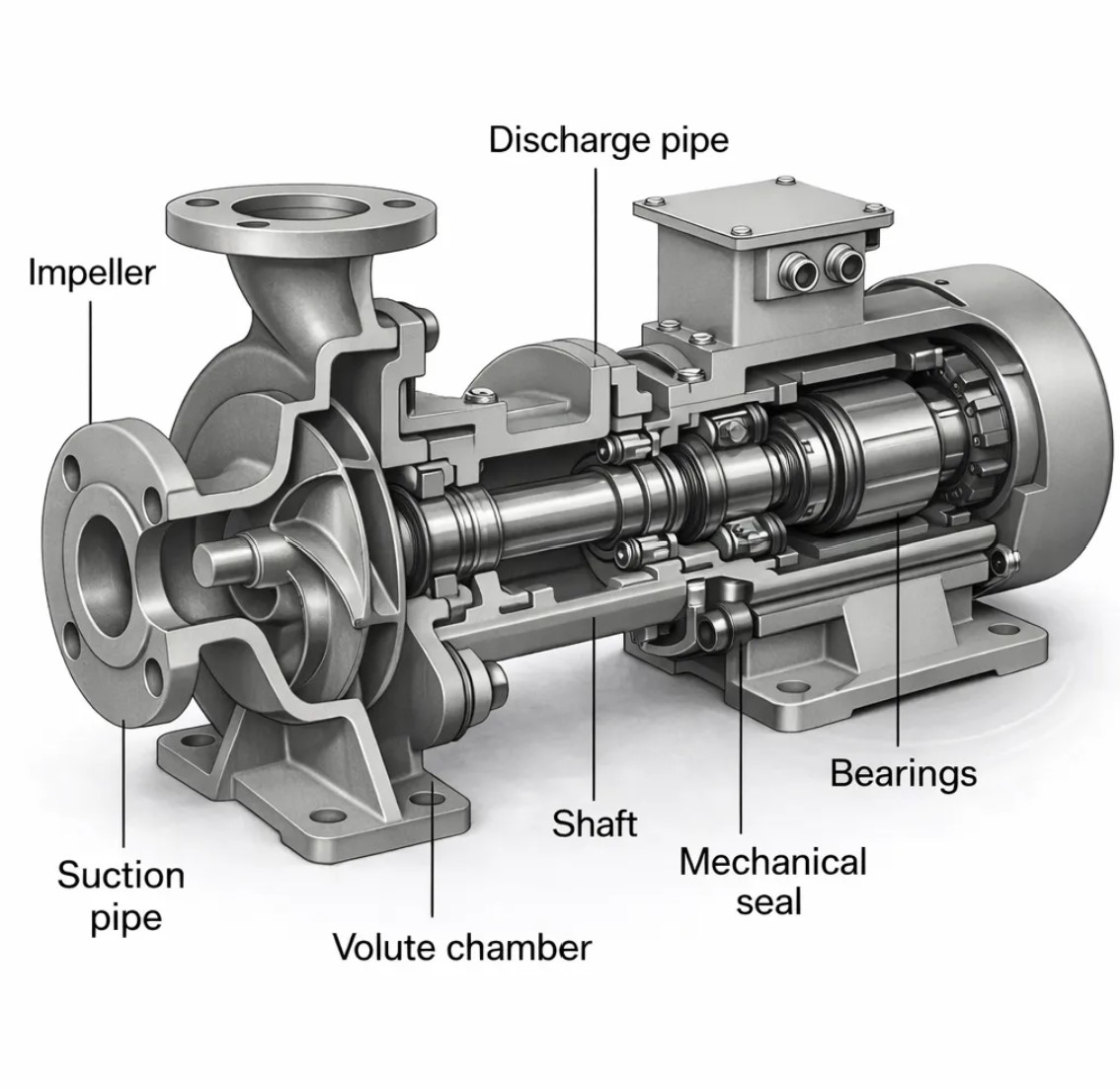
The centrifugal pump was first invented in 1689 by the physicist Denis Papin, and today it is the most widely used type of pump in the world. Its operation is based on a simple concept: liquid enters through the eye of the impeller and is then forced outward by centrifugal force toward the outer edge of the impeller. This design is economical, strong, and uncomplicated. Because of its high rotational speed, the pump can be directly connected to an asynchronous motor. Another advantage is that it delivers a continuous and stable liquid flow, and the flow can be regulated easily without damaging the pump.
Looking at Figure 1, the liquid enters the pump through the suction side and moves toward the center of the rotating impeller. From there, it is thrown outward to the impeller’s outer diameter. This arrangement provides high efficiency and makes the pump ideal for clean liquids. For applications involving contaminated fluids, such as wastewater, pumps are equipped with specially designed impellers that prevent solid particles from blocking the pump. Also, if there is a pressure difference in the system while the pump is stopped, liquid may still flow through it because of the pump’s open construction.
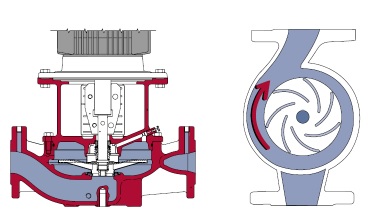
Fig. 1: The liquid’s flow through the pump
Types of Centrifugal Pumps
As shown in Figure 2, centrifugal pumps are divided into three main categories: radial flow pumps, mixed flow pumps, and axial flow pumps. Among these, radial flow and mixed flow pumps are the most commonly used types.
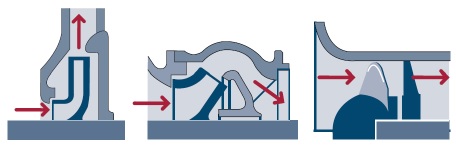
Fig. 2: Different kinds of centrifugal pumps
The large variety of centrifugal pump designs exists because different systems require different levels of head, flow rate, and installation conditions, along with the need for cost-effective operation. Figure 3 illustrates how various pump types differ in terms of flow capacity and pressure generation.
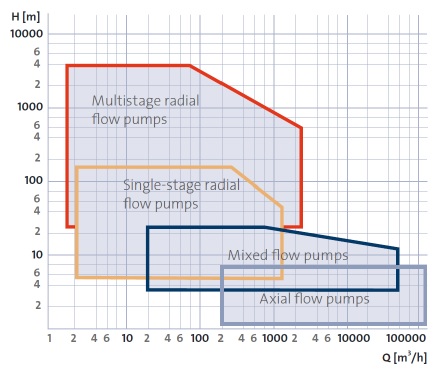
Fig. 3: Flow and head for different types of centrifugal pumps